
Archaeologists used to tell a single story about how human societies evolved to be larger and more socially differentiated: small, egalitarian groups with high levels of cooperation slowly turned into big, unequal states ruled coercively by powerful kings. The story made sense when early investigators excavated only the most elaborate palaces, tombs, and monuments of the largest sites. Yet over the past few decades, increasing evidence emerging from the homes people lived in, the ways they made a living, and their social groupings and institutions of scales intermediate between households and polities have challenged earlier unilinear and top-down models (Blanton and Fargher 2008; 2016; Carballo 2013; Carballo and Feinman 2016; 2024; Stanish 2017). Archaeologists now appreciate that there were diverse pathways to large-scale social formations and much greater variability in early systems of governance, with relatively participatory systems not only confined to the Classical Mediterranean or a few other moments in history. Some were driven by elites and could be more autocratic, but others were driven by cooperation towards mutual goals among neighbors, craft guilds, or civic groups. Closer attention to these intermediate-scale social groupings helps explain how past peoples organized shared resources, built infrastructure, and governed themselves in ways that were often surprisingly democratic.
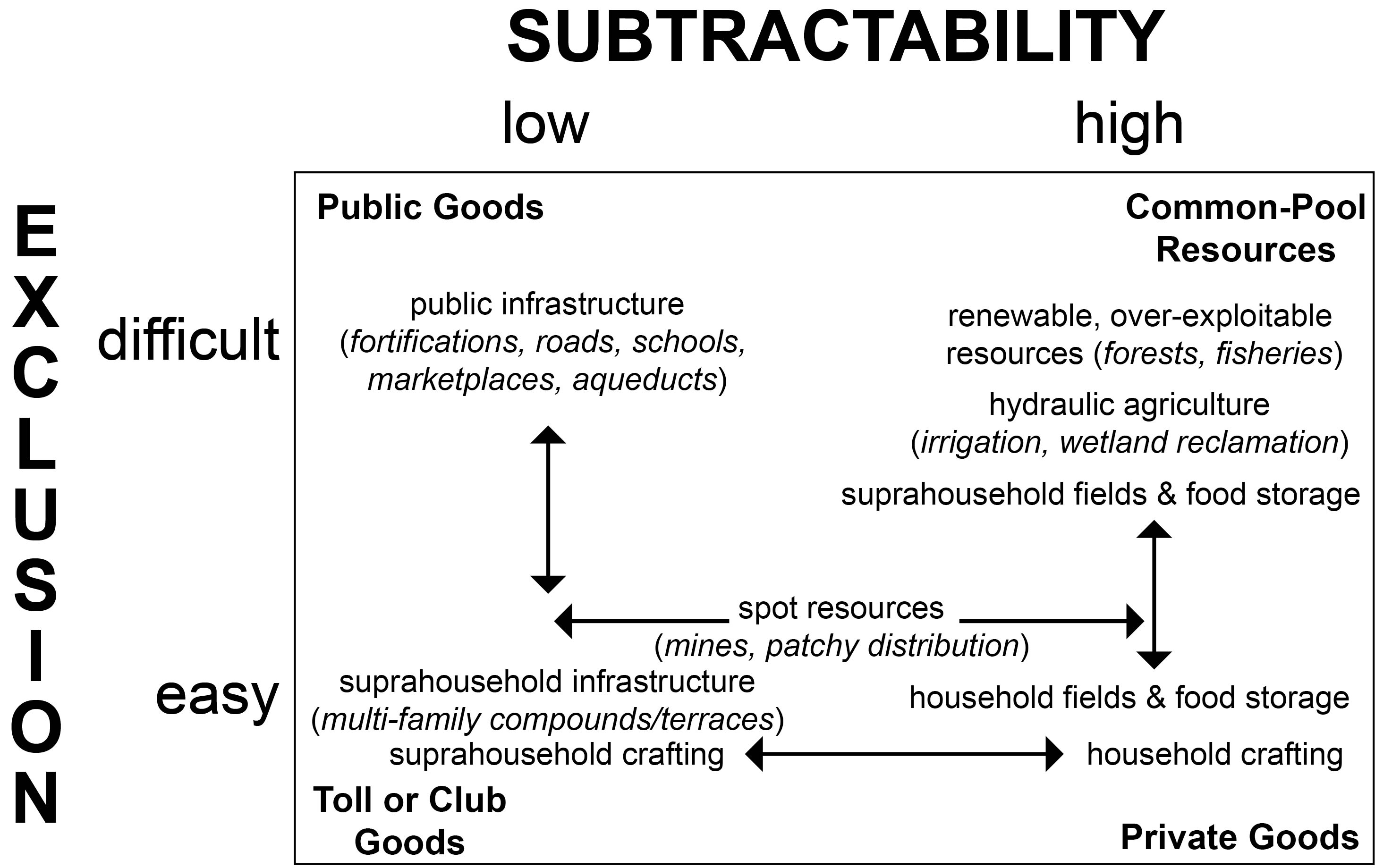
All this matters beyond archaeology because we continue to face problems of managing shared resources, building resilient communities, and defending participatory institutions of governance. The archaeological and historical records provide many past experiments in doing just these things for which broad societal outcomes and general correlations between relevant variables are known, though determining precise causes can be more difficult. A useful starting point is to think about how individuals and groups managed resources and public goods in ways like Elinor Ostrom and colleagues proposed for cross-cultural cases, some of them also having historical time depth (Ostrom 1990; Ostrom, Gardner and Walker 1994). Certain types of goods are rivalrous or have high subtractability: if one person catches a fish, it becomes unavailable to another. Some are easy to exclude people from, while others are more open and accessible. Archaeologists borrow that logic to evaluate the management of resources in past settings and how widely distributed the benefits were (Figure 1). Who organized subsistence infrastructure, such as irrigation systems or terrace networks? Was collective labor harnessed for constructions that benefited the few, such as for palaces or fancy tombs, or the many, such as for social infrastructure of public gathering spots or deliberative spaces for more participatory politics?
In many early societies, natural resources that we may classify today as public goods were conceived as emanating from divine actors. Rain, fertile soils, or health were often understood as gifts of the gods. But physical infrastructure, such as roads, aqueducts, defensive walls, public plazas, and community temples, had to be built and maintained by people. Some of that work was organized locally by neighbors or groups with shared occupations, while others could be managed by central institutions like temples or rulers. Recent studies have found that early urban centers in Mesoamerica with more shared local infrastructure tended to grow larger and last longer than counterparts with less of it (Carballo, Feinman and López Corral 2025; Feinman et al. 2023). Neighborhoods that built and used shared spaces likely had stronger social ties and greater resilience when times got tough.
A variety of social science research has demonstrated how much intermediate scale institutions matter. As the rules, norms, and regular practices people follow, institutions are the mediators between everyday life and large-scale polities (Levi 2006; Ostrom 2005). Archaeological and historical cases demonstrate how intermediate institutions such as corporate-kin groups, economic guilds, ritual sodalities, and neighborhood councils created the shared meanings and bonds of trust to organize labor and manage resources. People belonged to several groups simultaneously and this overlapping membership contributed to complex, flexible systems of governance that could place checks on rulers and sustain cooperative relations. We can find traces of these groups archaeologically. Material correlates include symbols of affiliation, craft workshops, administrative buildings, large residences or communal houses, and public social infrastructure like council houses or open plazas (Fargher et al. 2019). When they are available, texts can provide greater detail on these organization, but many key patterns are archaeological visible without them, in the subsistence and urban infrastructure seen in the built environment of past settlements and in their distribution of wealth in life (among houses) and death (within burials).
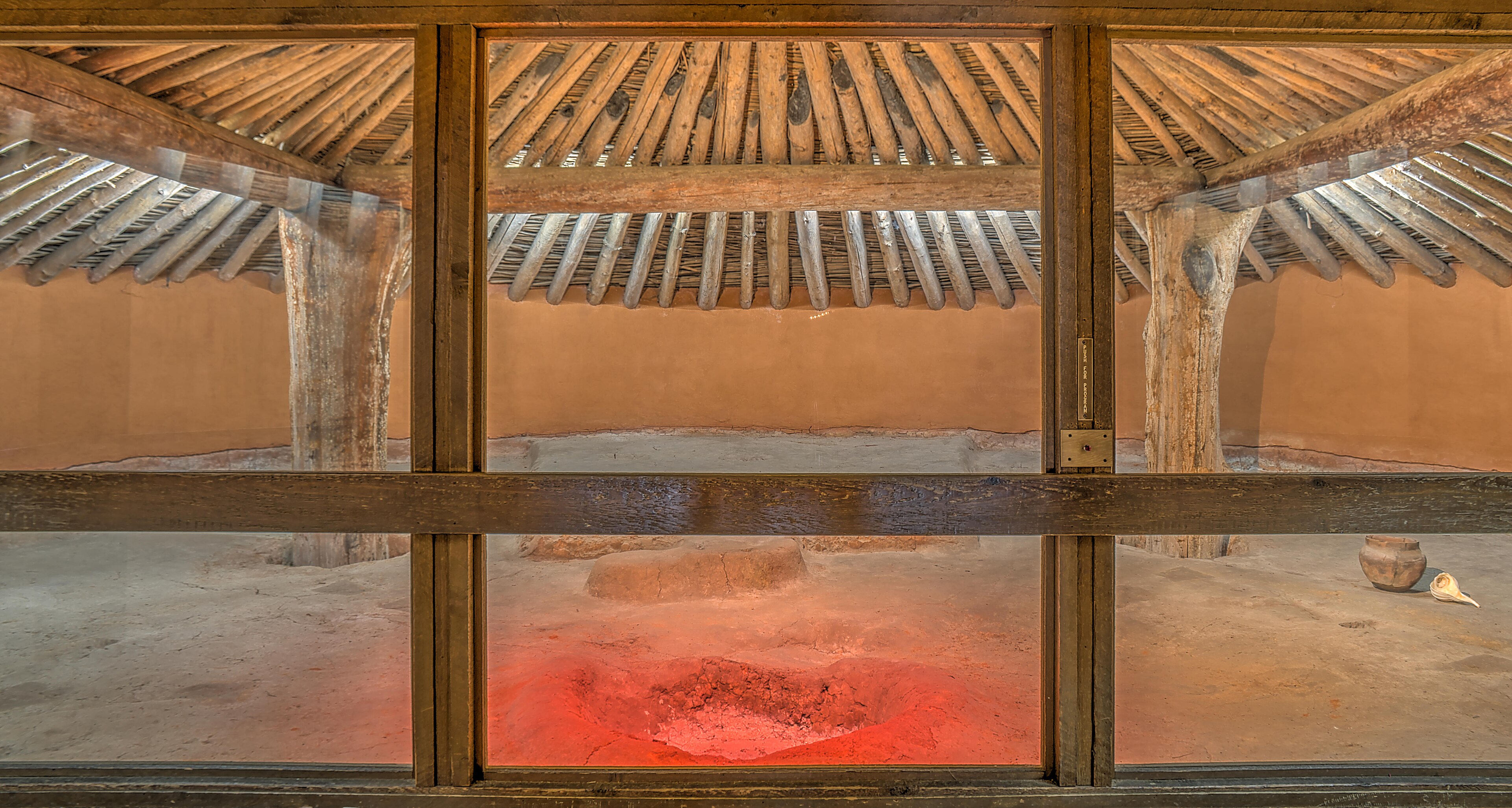
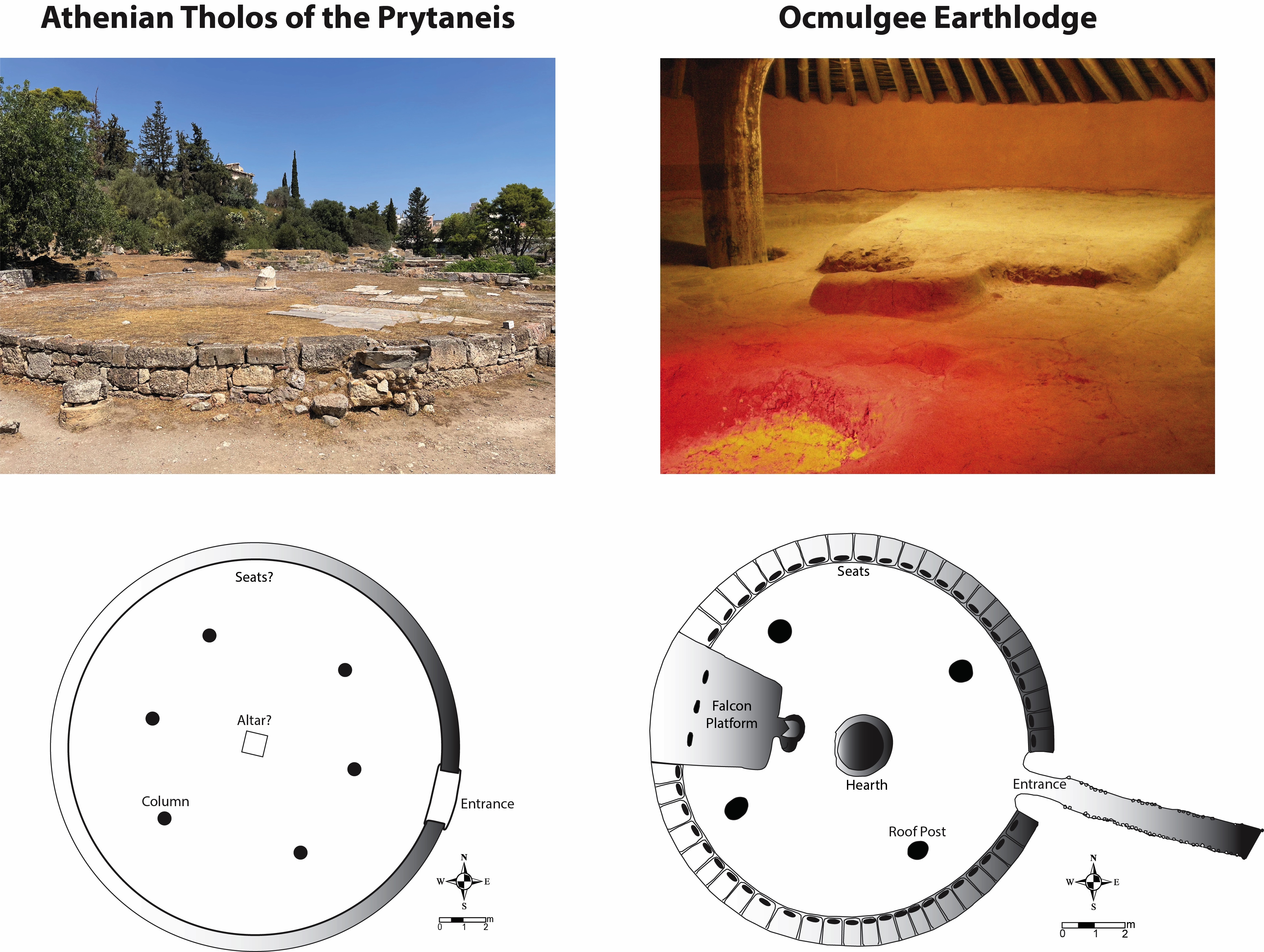
One of the clearest ways archaeology speaks to issues of governance is through public architecture: who could gather where, who sat above whom, and what rituals reinforced power or fostered inclusion. Open fora-like plazas, wide accessways, and buildings that encourage face-to-face visibility are architectural forms that support deliberation and participation. Conversely, palaces with restricted access, elaborate tombs, and dynastic monuments promote elite privilege. Two completely unrelated but strikingly similar examples, one from Classical Greece and one from the precolonial southeastern United States, show how the design of public buildings materially encapsulates political values (Figure 2). In Classical Athens, the Bouleuterion (council chamber) and associated Tholos (occupied by rotating councilmembers) embodied ideals of shared civic responsibility. The round plan of the Tholos and communal dining within it emphasized equality and rotating service in scheduling council agendas and upholding standardized weights and measures (Lang and Camp 2004; Steiner 2018). Across the Atlantic, the Muscogee (Creek) built their council houses with circular floor plans and peripheral benches that promoted mutual visibility during public deliberation, some being large enough to hold hundreds of people (Holland-Lulewicz et al. 2022). The formal similarities of these buildings highlight the fact that deliberative institutions of governance developed in a range of past societies.
Architecture can also reveal the varying degrees of inclusiveness within past cities. In parts of Mesoamerica, for instance, open plazas encouraged mass participation while adjacent elevated temple platforms had more limited access and separated elite ritual specialists from crowds below. When we have more texts available, we can appreciate subtle variation even within regions at the same time. Council houses could be integrated into palaces in more autocratic centers or set apart on neutral ground in more collective polities (Fargher et al. 2011; Carballo 2022). These choices make visible whether a society emphasized collective governance or concentrated power.
Research from fields such as political science and economics indicates that societies with more participatory institutions develop norms of cooperation that are capable of enduring political perturbations if sustained through collective investment (Acemoglu et al. 2011; Levi 2022). Archaeology adds a deep-time and material dimension to these observations. Shared infrastructure and recurring social interaction in public spaces foster mutual monitoring, the everyday visibility and repeated interaction that help people keep commitments and sanction free riders (Chwe 2001; Bowles and Gintis 2002). Over time, this produces social capital and institutions that are more robust in the face of crisis. But the archaeological record also reminds us that collectivity is not always benevolent or stable. Elites can co-opt communal symbols, and institutions meant to promote fairness can be undermined by the concentration of resources or by the capture of public projects for private gain.
What then do archaeologies of cooperation and collective action tell us about the present? The goal is not to inaccurately swing the interpretive pendulum in the other direction or pacify the past, but rather to consider a more complete range of human interactions that broaden our sense of possibility. The archaeological record contains many different examples of how people solved problems of resource management, public goods provisioning, and collective decision-making. Studying the material traces of infrastructure, the affiliations of intermediate groups, and the designs of spaces for public gathering provides us with concrete examples of past practices that worked over long periods. Those examples can inform contemporary debates about urban design, environmental sustainability, and how to support social institutions that balance inclusiveness with effectiveness. Some practical lessons for societal resilience learned from centuries of human history spanning the globe call for investments in local social and physical infrastructure, participatory institutions, and overlapping group affiliations that generate trust and mutual accountability.
References:
Acemoglu, Daron, Davide Cantoni, Simon Johnson, and James A. Robinson. 2011. “The Consequences of Radical Reform: The French Revolution.” American Economic Review 101, no. 7: 3286-3307.
Blanton, Richard E., and Lane F. Fargher. 2008. Collective Action and the Formation of Pre-Modern States. Springer, New York.
Blanton, Richard E., and Lane F. Fargher. 2016. How Humans Cooperate: Confronting the Challenges of Collective Action. University Press of Colorado, Boulder.
Bowles, Samuel, and Herbert Gintis. 2002. “Social Capital and Community Governance.” Economic Journal 112, no. 483: 419-436.
Carballo, David M. (editor). 2013. Cooperation and Collective Action: Archaeological Perspectives. University Press of Colorado, Boulder.
Carballo, David M. 2022. “Governance Strategies in Precolonial Central Mexico.” Frontiers in Political Science 4: 797331.
Carballo, David M., and Gary M. Feinman. 2016. “Cooperation, Collective Action, and the Archaeology of Large-Scale Societies.” Evolutionary Anthropology 25: 288-296.
Carballo, David M., and Gary M. Feinman. 2024. Collective Action and the Reframing of Early Mesoamerica. Cambridge University Press, New York.
Carballo, David M., Gary M. Feinman, and Aurelio López Corral. 2025. “Mesoamerican Urbanism: Indigenous Institutions, Infrastructure, and Resilience.” Urban Studies 62, no. 3: 507-524.
Chwe, Michael Suk-Young. 2001. Rational Ritual: Culture, Coordination, and Common Knowledge. Princeton: Princeton University Press.
Fairbanks, Charles H. 1946. “The Macon Earth Lodge.” American Antiquity 12: 94–108.
Feinman, Gary M., David M. Carballo, Linda M. Nicholas, and Stephen A. Kowalewski. 2023. “Sustainability and Duration of Early Central Places in Prehispanic Mesoamerica.” Frontiers in Ecology and Evolution 11: 1076740.
Holland-Lulewicz, Jacob, Victor D. Thompson, Jennifer Birch, and Colin Grier. 2022. “Keystone Institutions of Democratic Governance Across Indigenous North America.” Frontiers in Political Science 4: 840049.
Lang, Mabel, and John McK. Camp II. 2004. The Athenian Citizen: Democracy in the Athenian Agora. Revised edition. Athens: American School of Classical Studies.
Levi, Margaret. 2006. “Why We Need a New Theory of Government.” Perspectives on Politics 4, no. 1: 5–19.
Levi, Margaret. 2022. “Trustworthy Government: The Obligations of Government and the Responsibilities of the Governed.” Daedalus 141: 241-259.
Ostrom, Elinor. 1990. Governing the Commons: The Evolution of Institutions for Collective Action. Cambridge: Cambridge University Press.
Ostrom, Elinor, Roy Gardner, and James M. Walker. 1994. Rules, Games, and Common-Pool Resources. Ann Arbor: University of Michigan Press.
Steiner, Ann. 2018. “Measure for Measure: Fifth-Century Public Dining at the Tholos in Athens.” In Feasting and Polis Institutions, eds. Floris van den Eijnde, Josine H. Blok, and Rolf Strootman, pp. 205-232. Leiden: Brill.
Stanish, Charles. 2017. The Evolution of Human Cooperation. Cambridge: Cambridge University Press.
Thompson, Homer A. 1940. The Tholos of Athens and Its Predecessors: Hesperia. Supplement IV. Athens: American School of Classical Studies.
Header image: Ocmulgee earth lodge by Dsdugan via Wikimedia Commons