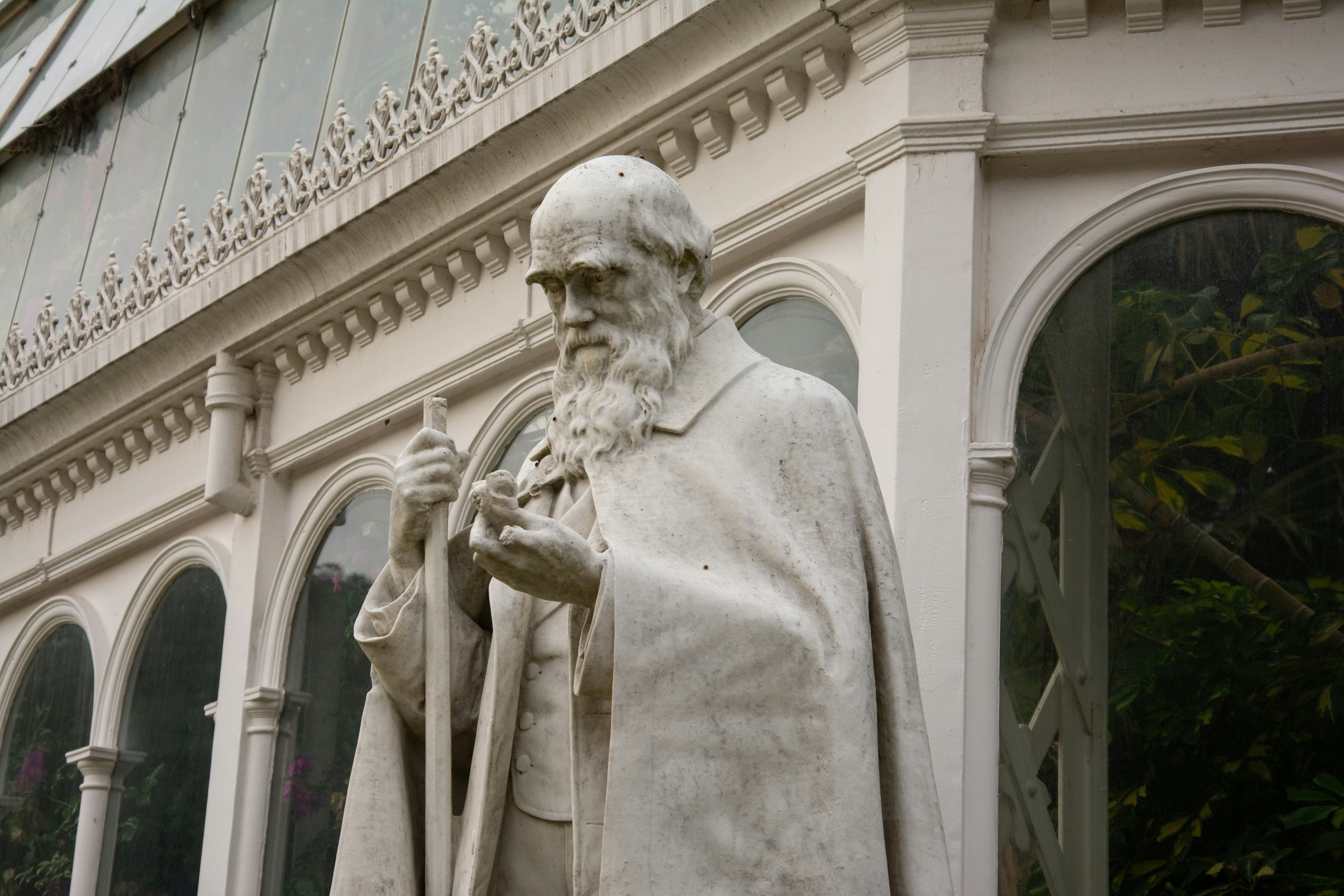
If you were to sum up the popular understanding of evolution in a single bumper sticker, it would probably be: "Nature: Red in Tooth and Claw." We’ve spent the last century convinced that life is an endless, brutal elimination tournament where the most selfish gene wins and everyone else gets turned into compost.
But on Darwin’s 217th birthday, which we celebrate today, the scientific community is having a bit of a "wait, there’s more" moment. The old-school Modern Synthesis—that 1940s marriage of Darwinian selection with Mendelian genetics—is being revamped. Enter the Extended Evolutionary Synthesis (EES): a more inclusive, less dogmatic, and surprisingly "gentle" understanding of how life actually works.
Beyond the Gene: The Extended Synthesis
For decades, biology was obsessed with the "Gene’s-Eye View." You were just a temporary meat-suit designed to carry around immortal strands of DNA. If a trait wasn't written in the AGCT code, it didn't count.
The Extended Evolutionary Synthesis argues that this is like trying to understand a five-star meal by only reading the grocery list. The ESS comes closer to seating us at the table. Here's what we'll find there:
Epigenetics: Think of this as the "software" to the DNA's "hardware." It turns out that life experiences—what you eat, how stressed you are—can flip switches on your genes that are then passed down to your kids. You’re not just inheriting your grandma’s nose; you might be inheriting the biological "memory" of the famine she survived.
Inclusive Inheritance: Beyond genes and epigenetics, culture and behavior count in evolution, too. A single Japanese macaque washes her potato in the ocean and a whole new world of seasoning food opens up to her descendants; male crickets in Hawaii stop chirping to avoid a parasitic fly, and twenty generations later the entire population is silent, a behavior driven not only by mutations, but also by changes in female mate choice and locomotion brought about by growing up in the hush.
Niche Construction: Traditional theory says the environment shapes the organism. EES says organisms shape the environment right back. Beavers don't just live in rivers; they build dams that change the entire ecosystem, effectively "engineering" the selection pressures for their descendants.
Developmental Plasticity: The ability of a single genotype to produce different phenotypes in response to environmental conditions is a driver of evolution, rather than just an outcome of it. Spadefoot toad tadpoles are small-headed gentle vegetarians, but can go “full Hannibal”, turning on their own kind to become ferocious cannibals, if they sense their ponds are drying out.
Developmental Bias: Evolution isn't a total crapshoot. The way an embryo grows limits and directs the kinds of mutations that are even possible. You can't just mutate a wing onto a pig; the "blueprint" of a pig’s development simply won't allow it, no matter how much the pig wants to fly.
Evolvability: The ability of a lineage to generate, and even potentially increase, its capacity for future adaptive evolution through genetic, developmental, and ecological mechanisms. Introducing anole lizards arriving on Jamaica and quickly specializing into canopy (large toe pads), twig (short legs) and grass dwellers (long tails), respectively.
The Return of the Group: Selection at Scale
Perhaps the most "controversial" comeback in modern biology is Group Selection, or Multilevel Selection. For years, saying "group selection" in a biology department was a great way to get uninvited from the faculty Christmas party. The dogma was: selection happens to individuals, period. If an animal acts "altruistically" (like a bird screaming to warn the flock about a hawk), it’s only doing it to save its own relatives.
Today, following in the steps of V.C. Wynne-Edwards and George Price, researchers like David Sloan Wilson are proving that "Selfishness beats altruism within groups. Altruistic groups beat selfish groups." Imagine two tribes of early humans. Tribe A is full of "every man for himself" types—super fit, super fast, and super likely to steal their neighbor’s spear the moment a saber-toothed tiger shows up. Tribe B is full of "average" people who cooperate, share food, and watch each other’s backs. In a one-on-one cage match, the selfish guy from Tribe A wins. But in a survival contest over a brutal winter, Tribe B survives while Tribe A collapses into a chaotic mess of spear-theft and betrayal.
Today, the logic of Darwinian multi-level selection theory married to design principles developed by the Nobel laureate economist Elinor Ostrom is being applied to better society, in ways that would have tickled contemporaries of Darwin such as Harriet Martineau, George Elliot and Thomas Hardy. Herbert Spencer and Darwin’s cousin Francis Galton, too, would have been piqued, surprised perhaps at new ways of thinking of culture that don’t stratify, shun or coerce but rather invite people to draw on universally ingrained capacities for empathy and cooperation. Instead of waiting for genetic evolution, or enforcing it, this approach uses cultural evolution — the faster transmission of learned behaviors, norms, and institutions — to help strengthen group identity, render distribution of costs and benefits more equitable, and bring swift and peaceful resolution to conflict. By structuring communities, schools, or businesses as "highly cooperative groups," these methods reduce internal conflict and enhance collective productivity.
What Would Charlie Think?
So, what would Charles Darwin think of all this if we brought him back to 2026? After we explained the concept of a "smartphone" and helped him recover from the shock of seeing a pigeon in a tutu on TikTok, he’d probably be... remarkably chill about it.
Darwin was way ahead of his time on these "modern" debates. Here he is, famously, in The Descent of Man: "When two tribes of primeval man, living in the same country, came into competition, if (other circumstances being equal) the one tribe included a great number of courageous, sympathetic and faithful members... this tribe would succeed better and conquer the other."
Darwin was rather clueless about the workings of heredity - he famously offered a wildly incorrect “Provisional Hypothesis of Pangenesis” - but he had a keen intuition for the "soft" side of evolution. He was obsessed with the way organisms interacted with their surroundings. He probably would have loved Niche Construction having written an entire book on how earthworms literally create the soil of the world. He would be glad to know that the hard and fast divides between soma and germ line, and between organism and environment, are blurring more than at any time since the days of August Weismann. He might, however, be a bit miffed at how "Darwinism" became a synonym for "ruthless competition." Darwin was a sensitive guy who cried at the thought of animal cruelty; the idea that his theory was being used to justify "survival of the greediest" in 1980s Wall Street boardrooms and 2020s Silicon Valley café’s would have made him reach for his snuff box in annoyance. A little bit more Kropotkian “mutual aid” and a little less Huxlian “cosmic evolution” would have hit the mark for him.
The 2026 Outlook: A More Collaborative Tree
Evolution today isn't just a story of winners and losers. It’s a story of Symbiogenesis, where different species merge to become something new; of Horizontal Gene Transfer, where bacteria swap DNA like trading cards; and of Cultural Evolution, where ideas change us faster than genes ever could. We’re moving away from the "Tree of Life" and toward something more like a "Web of Life." It's messier, more complex, and significantly more interesting. Nature isn't just a battlefield; it’s a massive, multi-generational DIY project where the players are constantly changing the rules as they go. And honestly? That’s a much better story.