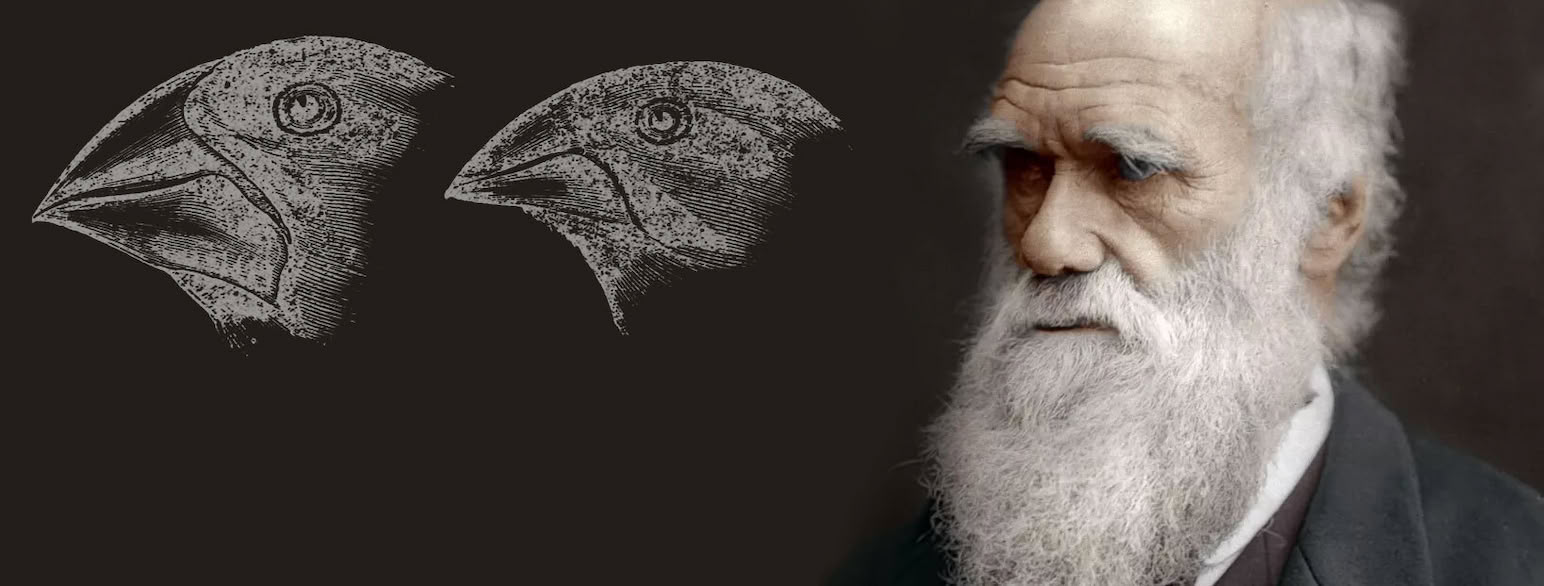
David Sloan Wilson writes, “For many people, the word 'Darwinism' signifies the moral justification of inequality (so-called social Darwinism). Work will be required to establish what is meant by the term and how the new paradigm is centered on cooperation and inclusion.”
Which Darwin are we talking about?
I believe that the reason for using “Darwinism” here is that the word is so used by neo-Darwinist evolutionary biologists, such as Richard Dawkins (1976, 2016) and Daniel Dennett (1996), who believe that evolution is entirely explained by random mutations and Natural Selection. I believe Wilson is correct to say that this view is often used as a justification of inequality since we could say that it is correct for the Darwin who wrote On the Origin of Species in 1859. But, I do not believe that the later Charles Darwin could have possibly accepted the use of his name by the neo-Darwinists. My reason is that he permanently broke with Alfred Russel Wallace on precisely this issue in 1866. To quote Darwin’s biographers, James Moore and Adrian Desmond, in 1866-7:
“Wallace turns to Spiritualism and effectively puts human mental powers beyond natural explanation. He sees natural selection as explaining the physical body, and denies any role for sexual selection. Darwin, upset by this, is finally galvanised into writing on racial divergence by means of sexual selection. He starts assembling information and projects a full-length book.” (Moore, J. & Desmond, A. 2004, Introduction of Penguin Edition of Charles Darwin’s The Descent of Man and Selection in relation to sex, p. ix)
That ‘full-length’ book was first published in 1871 as two volumes under the titles The Descent of Man, and Selection in Relation to Sex. Having said relatively little on human evolution in The Origin of Species, Darwin was now intentionally addressing issues on human evolution and processes in addition to Natural Selection that he had largely avoided in The Origin of Species. Darwin’s ideas in these two books included his theory of pangenesis and his proposal of the process of Sexual Selection, through which he also gave conscious agency to some animals, notably including birds.
To quote Moore & Desmond again:
“Darwin’s trajectory towards the Descent of Man has to be seen against this changing Victorian backdrop. Nothing less will reveal the growth of his vision of racial divergence at the root of human evolution, or how he came to its cause, sexual selection.” (p. xii)
Sexual Selection is key, since Darwin was firmly in the camp of attributing intentional agency to humans and also to other organisms. It could also have been called Social Selection, because his deep opposition to slavery was central to this issue.
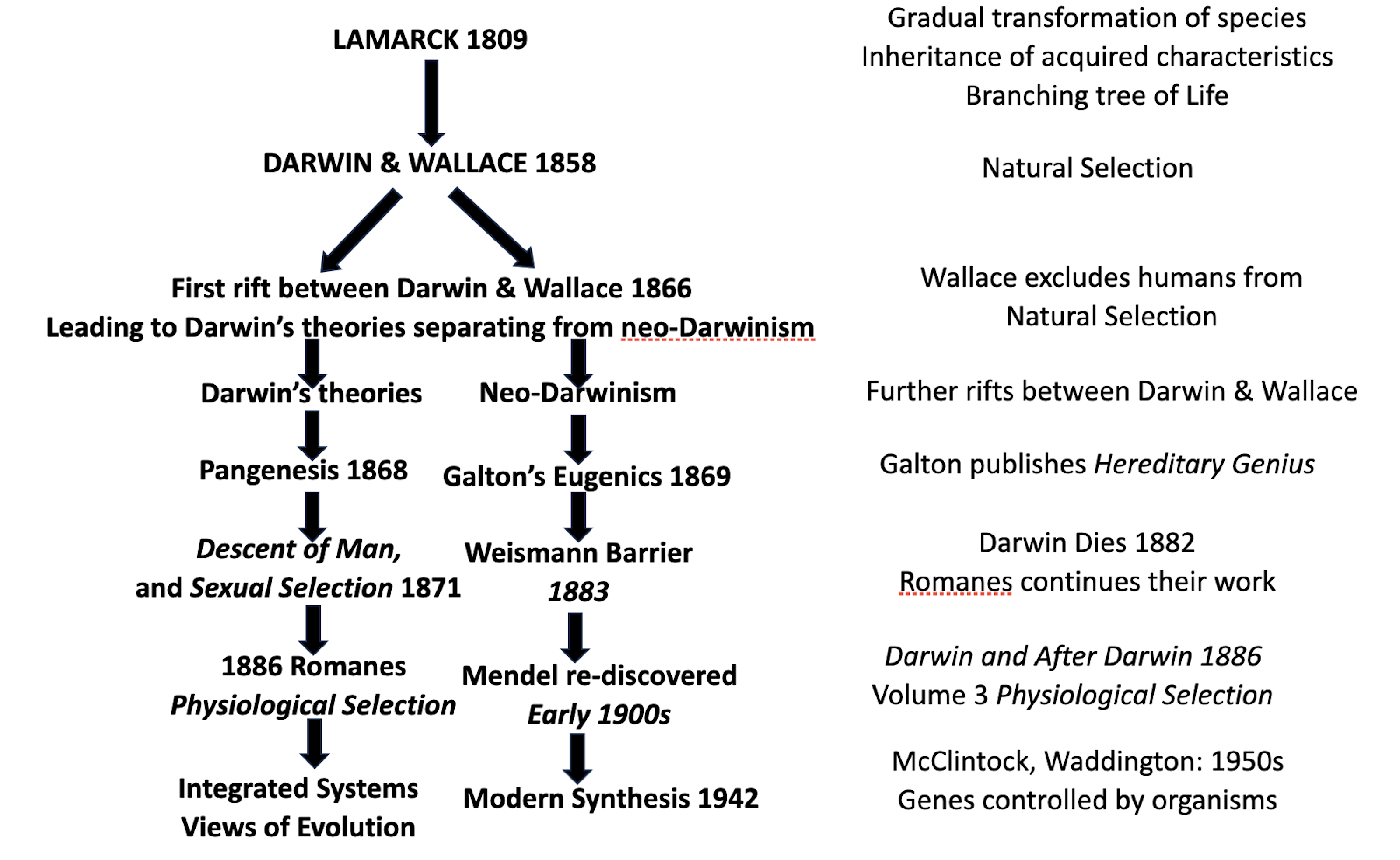
Ray Noble and I (Noble & Noble, 2026) have reconstructed the timeline above to correct these errors of neo-Darwinists on the history of Charles Darwin and his reaction to Wallace, Galton, and others during the 19th century foundation of neo-Darwinism. The diagram shows that the split between Darwin and Wallace in 1866 became permanent. I believe it does an injustice to Charles Darwin’s work to continue to use his name for neo-Darwinism. I recommend that we call it gene-centric evolutionary biology. It is biology as outlined in The Selfish Gene. First in 1976 (Dawkins, 1976), and more recently confirmed in (Dawkins, 2016).
Those books in 1868 and 1871 were written in strong opposition to the early neo-Darwinists. In his 1868 theory of pangenesis (Darwin, 1868), he became even more Lamarckian than Lamarck through developing a theory, pangenesis, that provided a mechanism by which Lamarckian inheritance could work.
Granting conscious choice to organisms is the first significant step towards a cooperative view of evolution and its implications for social sciences like economics, favoured by Wilson. This split between Darwin and Wallace is therefore central to the historical background of current arguments about evolution.
References:
Darwin, C. 1859. On the Origin of Species by Means of Natural Selection or, the Preservation of Favoured Races in the Struggle for Life. London: John Murray.
Darwin, C. 1868. The variations of animals and plants under domestication. London: John Murray.
Dawkins, R.D. 1976. The Selfish Gene. Oxford: OUP.
Dawkins, R.D. 2016. The Selfish Gene. 40th Anniversary Edition. Oxford: OUP.
Dennet, D. 1996. Darwin’s Dangerous Idea. Evolution and the meanings of life. Simon & Schuster.
Desmond, A. & Moore, J. 1991. Darwin. Michael Joseph Ltd.
Moore, J. & Desmond, A. 2004. Introduction. In Darwin, C. 2004. The Descent of Man. Penguin Classics. pp. xi - xviii.
Noble, D. & Noble, R. 2026. Darwin, Consciousness, and the physiology of agency. In (Dembski, Ed) Darwin & Design: The Ongoing Debate on Biological Origins. Cambridge University Press. In press.
Wilson, D.S. 2026. On the Concept of Paradigms and a New Paradigm for Evolving Cooperative Systems. ProSocial World.