The title of David Sloan Wilson’s target article was focused on “paradigms”, setting the stage to define them, evaluate them, and offer a new one to replace poorly performing current ones. For some background, I have expressed serious criticisms about the book where Kuhn originally explored and developed this term,1 but Wilson avoids those issues and develops a remarkably clear set of useful recommendations that I wholeheartedly endorse. And while paradigms were the main focus of the article, I was particularly struck by Wilson’s curation of “toolkits” to help those of us who want to operate within his proposed paradigm. Anyone who has ever wandered the aisles of a big box hardware store will be aware of the thousands of specialized gizmos that have been created and stocked for many obscure purposes. Creating a toolkit of essential items from this inventory requires wisdom about the whole field of construction in order to make it just the right size. The same can be said for toolkits from scientific disciplines, and yet Wilson seems to have plucked just the right ones for complexity science and universal Darwinism.
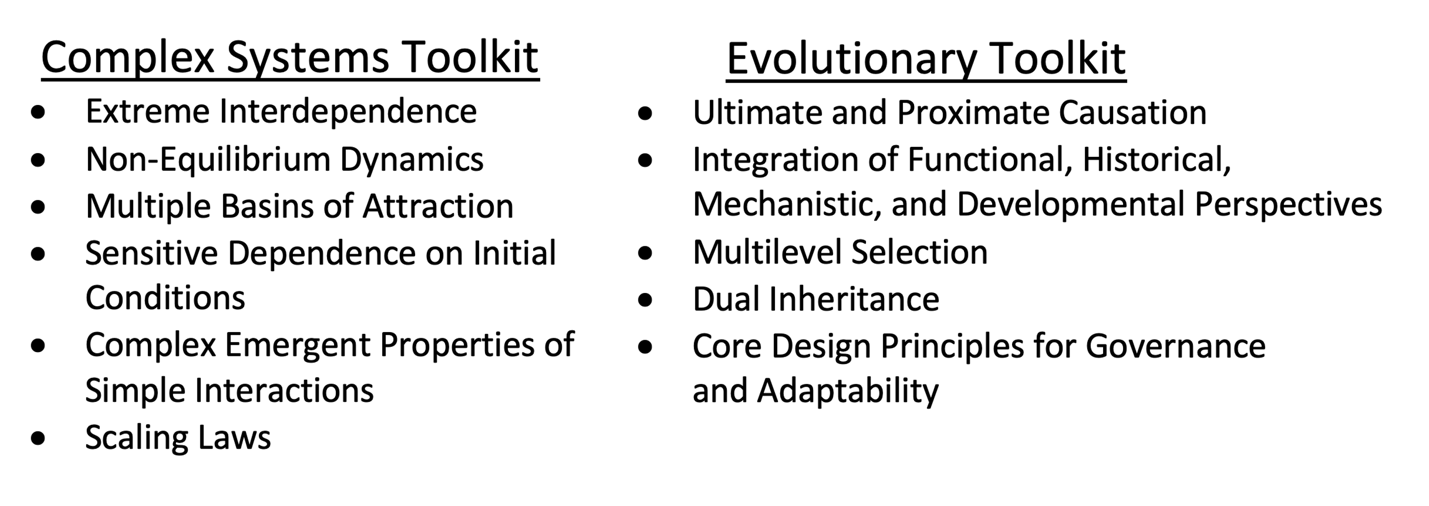
These are two concise yet powerful lists, and they are capable of doing many jobs to help the new paradigm rise. But I would like to propose a third leg for these toolkits to help everything stand even more sturdily. About halfway through the article, Wilson mentions in passing that:
Many scientific paradigms only attempt to describe what is and make no effort to prescribe what ought to be done.
But this, of course, is because David Hume’s “is-ought divide”2 is one of the most famous barriers in philosophy for any system of thought that wants to prescribe an ought. Science alone (or even scientific paradigms) will not get you there. You need philosophical arguments to do this. In my own philosophical work, I have proposed a bridge across this divide3 by recognizing that satisfying our “wants” is what drives our decisions about what we ought to do. For example, if there is a bus at 3 pm to Albany, and I want to go to Albany, then I ought to take that bus. (Ignoring other modes of transportation for this simple demonstration.) Finding the right want is how we can make the right prescriptions. For our moral oughts, I have argued that the most basic want on which ethics are built is the desire for life in general to survive and thrive. The specifics of how best to achieve that are then contained in a clear boundary for discussion. Not all philosophers see it this way, but many are generally occupied with promoting actions that lead towards the survival/thriving/well-being/mattering of living/sentient/conscious/capable creatures. The squabbles over the details in these arguments could be seen as another example of Kuhn’s and Wilson’s “paradigms as containers for productive disagreement.” (For those that question it, moral philosophy has actually been “productive” at winnowing out arguments that used to favor tribes, sects, or even species in their moral prescriptions.)
This is but one example of what I would say is an unnamed branch of thought that is waiting to be recognized and more clearly defined. I would call it “evolutionary philosophy,”4 and even though there isn’t a Wikipedia entry for that term yet, I have been writing essays since 2012 about evolutionary ethics, evolutionary epistemology, and evolutionary aesthetics (all of which do have Wikipedia entries), as well as politics and metaphysics that are evolutionarily inspired too. Although these traditional branches of philosophy are usually kept siloed apart from one another, bringing them together under one banner creates a very broad and comprehensive worldview with plenty of places for disagreement about the details. That sounds to me like the elements of a paradigm according to Wilson’s (and Kuhn’s) definitions. The essays in this field are quite prescriptive while trying to be as factually accurate as possible, too. Thus, they may score well on Wilson’s criteria for judging paradigms, although their scores would surely improve if they incorporated more tools from complexity science and generalized Darwinism.
Upon reading Wilson’s essay, I realized that even though evolutionary thinkers may arrive at differing conclusions, they very often use many of the same concepts across the various philosophical subdomains. That makes these concepts perfect candidates to be a toolkit for evolutionary philosophy, and I hope that presenting them here could help bolster the field. Perhaps I’m not the wisest philosopher to make the best selection of concepts for this field, but many of them come from the works of Dan Dennett, who spent a long and illustrious career exploring Darwin’s thought as it pertained to several philosophical issues. In keeping with the spirit of evolutionary adaptation, further refinement of these tools would be expected and most welcome, but for now, here is my starting list.
Evolutionary Philosophy Toolkit
- Naturalism / Physicalism as a Defendable Place to Start
- Darwin’s “Strange Inversion of Reasoning” from Top-Down to Bottom-Up
- Fuzzy Lines of Gradualism Rather than Perfect Boxes of Essentialism
- Consciously Following Evolutionary Processes Produces Solutions that Survive
- Hierarchies Help to Make Sense of Slow and Continual Emergence
- Evolution is a Universal Acid
1. Even Christian scholars accept “methodological naturalism” for their science since it is both productive and defensible while remaining distinct from their personal metaphysical beliefs.5 Philosophers would probably be wise to adopt the same strategy, and this has been urged by some members of the field.6 This especially makes sense in an evolutionary philosophy paradigm where the findings of evolutionary science are used to shed light on traditional problems in philosophy (as opposed to “philosophy of evolution” where traditional tools from philosophy are brought to bear on the science of evolution).
2. Once the processes of evolution were discovered, we came to understand biology by building from the bottom up, rather than using imaginary sky hooks to descend from the top down via a heavenly creator. Dan Dennett called this Darwin’s “Strange Inversion of Reasoning”,7 which he illustrated with a passage from a contemporary critic of Darwin who thought it madness to exchange Absolute Wisdom for Absolute Ignorance as the starting point for life on Earth. But that is widely accepted in biology now, and should be adopted in fields like epistemology, ethics, and the metaphysics of consciousness studies.
3. Since at least Ancient Greece, philosophers have loved to draw neat and tidy little boxes around the world and try to use rigorous logic to define and analyze things beyond any and all reasonable doubt. But in his essay “Darwin and the Overdue Demise of Essentialism,”8 Dan Dennett argued that this has actually been an impossible-to-reach goal. With the revolutionary discovery by Darwin that the world is not composed of such eternal, hard-edged, in-or-out classes of things, philosophers should abandon their search for pure essences and instead focus on gradualist theories of complex phenomena, including such things as knowledge, well-being, sentience, harm, free will, or beauty.
4. In his 2011 TED talk titled “Trial, error and the God complex,”9 the economics writer Tim Harford (who also studies complex systems!) described a fascinating instance of how manufacturers had used evolutionary thinking to design a fluid nozzle where their best mathematical modeling had failed. Through a series of variations, trials, and then selections, which could be tweaked for more variations, the engineers on the project eventually arrived at a design that they never could have imagined at the beginning of their attempts. The conscious use of this evolutionary process of variation, selection, and retention could yield great benefits wherever we would like to prescribe what we ought to do in complex situations. We don’t need a precise plan at the outset that can foresee what all of the steps in our journey will look like, but we should be confident that following this process will get us where we want to be.
5. Our new gradualist view of the evolving universe doesn’t need to remain strictly confined to fuzzy shades of grey over a vast continuum. The evolutionary biologist Ernst Mayr, who coined the proximate/ultimate distinction, claimed that “all problems of biology, particularly those relating to emergence, are ultimately problems of hierarchical organization.”10 Mayr used this to create hierarchies of species, which have made the science of biology much clearer and more powerful. Similarly, philosophers can use hierarchies to elucidate the emerging complex phenomena described in tool number 3 above.11
6. Finally, we have a meta-tool from Dan Dennett who famously called the idea of evolution a universal acid because, “it eats through just about every traditional concept, and leaves in its wake a revolutionized world-view, with most of the old landmarks still recognizable, but transformed in fundamental ways.”12 This view of life should not be confined to just the evolutionary sciences. It has the power to alter all of our philosophical thinking, and we should not be timid about applying our toolkits there.
I believe this evolutionary philosophy toolkit can help philosophers in particular and thinkers in general make better arguments about the nature of reality. It can also be used to help bridge Hume’s is-ought divide, thus giving more strength to our prescriptions and making Wilson’s “New Paradigm for Evolving Cooperative Systems” just a little more complete according to his own criteria. I know I have already gladly incorporated Wilson’s toolkits for complexity science and generalized Darwinism into my own intellectual garage. I hope these philosophical tools will be considered useful additions as well.
References:
[1] Gibney, E. “An Evolutionary Note about The Structure of Scientific Revolutions by Thomas Kuhn”
[2] See https://en.wikipedia.org/wiki/Is–ought_problem for an overview.
[3] Gibney, E. (2015) Bridging the Is-Ought Divide: Life is. Life ought to act to remain so. Association for the Study of (Ethical Behavior)•(Evolutionary Biology) in Literature Journal, Volume 11, Issue 1: 17-28.
[4] See my website with this name for much more about evolutionary philosophy: https://www.evphil.com/.
[5] McDonald & Tro. “In Defense of Methodological Naturalism.” Christian Scholar’s Review. June 15, 2009.
[6] See: Ladyman and Ross, Every Thing Must Go: Metaphysics Naturalized, Oxford University Press, 2007. Pigliucci M. “Metaphysics Dissolved. Because Who Needs It?”, Medium, Feb 24, 2022. Veit, W. “A Third Kind of Philosophy”, Psychology Today, Jan 21, 2026.
[7] Dennett, D. “Darwin’s ‘Strange Inversion of Reasoning’”, Proceedings of the National Academy of Sciences, 106 (Supplement 1), June 2009, p. 10061.
[8] Dennett, D. “Darwin and the Overdue Demise of Essentialism”, How Biology Shapes Philosophy: New Foundations for Naturalism, Cambridge University Press, 2016, pp. 9-15.
[9] Harford, T. “Trial, error and the God complex”, TED Global, July 2011.
[10] Conley, B.A. “Mayr and Tinbergen: disentangling and integrating”, Biology & Philosophy, Vol 35, article 4, 2020.
[11] For example, I have a forthcoming paper on a hierarchy of knowledge and am also developing papers on a hierarchy of consciousness and free will.
[12] Dennett, D. Darwin’s Dangerous Idea, Simon & Schuster, 1995, p. 63.