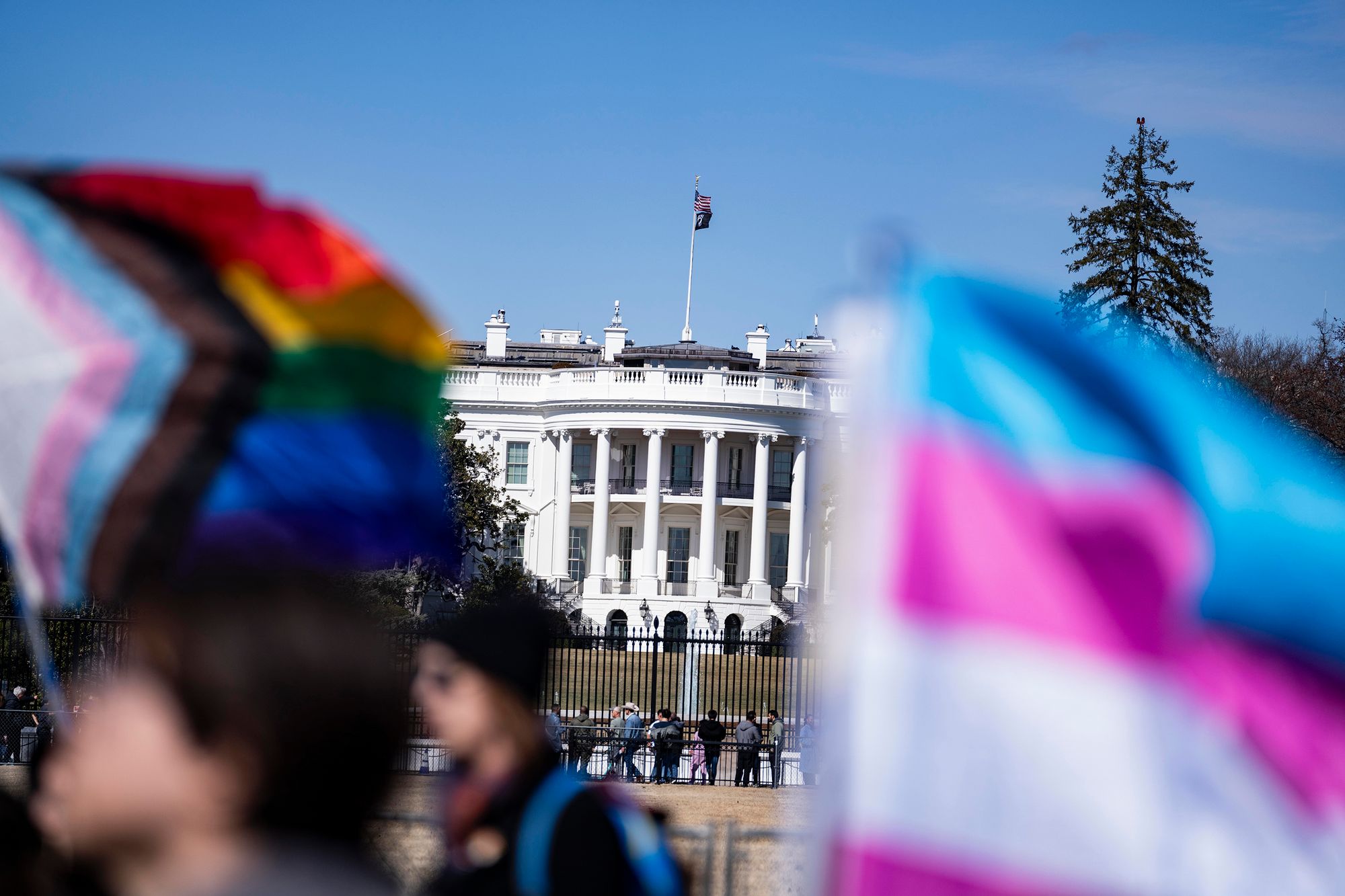


Thanks to generations of activism and scholarship, and despite the current backlash, 21st-century scientists and non-scientists are increasingly accepting—and celebrating!—the fact that sex is non-binary. It is becoming far more widely understood that, rather than being locked into either of the overly reductive categories of female or male, sex exists along a spectrum (with perhaps a bimodal distribution).1–6 While we authors welcome, and also celebrate, evolutionary biology’s slow-but-sure liberation from the limitations of binary sex, we submit that no sexual liberation can be complete without racial liberation. As we argue in our book, Feminism in the Wild, scientists who study or otherwise engage with the theory of evolution must reckon honestly with the racist skeletons buried in the evolutionary biology closet, especially as they shape conventional understandings of sex and sexuality.7
Before Darwin’s theory of evolution rose to prominence, the prevailing belief among Europeans and Anglo Americans was that of polygenism, or that different human “races” constituted different human species.8 European and Anglo-American scientists further believed that these different species of humans—the precise numbers and names of which varied across time and place—were ranked hierarchically, positioning the so-called Caucasian race at the top.9,10 While Darwin’s arguments for monogenism (i.e., that all humans are the same species) eventually superseded those of polygenism, the pre-existing racial hierarchy did not disappear. White scientists simply re-labeled their species categories as racial categories of humans, designating white people—or, more specifically, the young adult, able-bodied, heterosexual white male—as the pinnacle of evolutionary progression.11 And one of the key pieces of “evidence” for the evolutionary superiority of the “white race” was the purportedly greater distinction between male and female physiology, known as sexual dimorphism.12 (Indeed, this binary sex-based classification system went well beyond the human species; European and Anglo-American scientists tended to classify species with fewer physiological distinctions between those labeled male and those labeled female as lower on an evolutionary scale.13) Hence, those of us invested in dismantling the sex binary must grapple with the historical reality that 19th-century theories of sexual dimorphism emerged from and reinforced racist hierarchies as well as heterosexist hierarchies—and not simply in tandem but rather enmeshed. In other words, sex categories were defined through racial categories.
What is more, European and Anglo-American researchers well into today continue to study and describe living descendants of some of the world’s oldest continuing civilizations—such as African Masai and Aboriginal Australians—as “the missing link” between apes and humans, thus still implying that these people of color somehow haven’t evolved along with the rest of white humanity.14,15 As political scientist Claire Jean Kim puts it, race has long been used as a “metric of animality,” meaning that the racialized people who European and Anglo American scientists categorized as “less evolved” (in large part because of their supposed lack of sexual dimorphism) were therefore perceived as lesser forms of human, or more animal-like.16 This 19th-century scientific act of categorizing racialized groups of people as less than fully human was key to rationalizing the enslavement, dispossession, and oppression of racialized peoples over the last several centuries.
Ironically, even as dominant science categorized racialized people as being less sexually dimorphic, the dominant culture also hypersexualized people of color. Black feminist sociologist Patricia Hill Collins memorably documents how white enslavers promoted racialized and animalized stereotypes of Black men as sex-crazed “Bucks,” and Black women as sex-crazed “Jezebels,” a characterization that served to justify the enslavers’ horrific practice of forcing rape among the enslaved, so as to procure the next generation of enslaved humans at no cost to the enslaver.17
The racist and sexist belief that “sub-humans” and animals—particularly those categorized as male—cannot, or should not, resist their own sexual urges, also creates serious misconceptions in nonhuman biology.18 Alongside those scholars and activists producing ample evidence of the spectrum of sex (in refutation of the binary), generations of researchers have similarly shown the heterosexism baked into sexual selection, such as the stubbornly persistent trope of the coy, monogamous female and the eager, promiscuous male, or the continued insistence that same-sex sexual behavior among animals is either an evolutionary anomaly or a paradox.19–21
Sexual selection relies on the assumption that females actively choose the “best” male with whom to produce offspring. This assumption itself rests on another assumption, which is that “best” means either the most attractive, also known as the runaway hypothesis, or the strongest or healthiest, a.k.a. the good genes hypothesis. In either case, the best male is understood as the male with the greatest evolutionary fitness. As we write in Feminism in the Wild: “the logic of … both the good genes and the runaway hypotheses… enlists individual animals, females in particular, into doing the work of choosing who gets to reproduce and who does not, based on perceivable indicators of males’ superior or inferior genes (whether for pragmatic or aesthetic reasons). This is the same logic that eugenicists apply to human populations … encouraging those people with ‘favorable’ traits to breed,” while discouraging or even actively prohibiting people with “unfavorable” traits from reproducing, such as through forced sterilization programs.7
Eugenics was of course a fundamentally racist (not to mention heterosexist, classist, and ableist) science, wherein Europeans and Anglo Americans cast people of color, queer people, poor people, and people with disabilities as having traits that made them both less attractive and less fit.22–24 Over the last century and a half, evolutionary biology has fairly consistently posited that animals, too, are somehow eugenicist. In his 1871 The Descent of Man, Darwin wrote that “racial features were akin to … variations in bird plumage—largely aesthetic traits that had originated and been sculpted by the sexual preferences of members of that species.”25,26 Darwin further contended that each human “race” had its own beauty aesthetic, thereby constructing a schema in which “sexuality became the engineering force for race itself.”25 It is important to locate Darwin’s writings on natural and sexual selection in their historical context; for it was after the official abolishment of chattel slavery, and thus in a moment of high anxiety about the threat that newly-freed African Americans might pose to white America, that Anglo-American researchers were reading and applying the British naturalist Charles Darwin’s work. (Darwin’s own position on the institution of slavery remains contested.27,28) White America feared both violent forms of revenge from African Americans and subtler changes in social behavior, worrying, in other words, that increasing numbers of mixed-race people would further blur the color line in a post-slavery society. As historian Myrna Perez Sheldon notes: “Polygenists had worried that racial amalgamation could result in human extinction. But after Darwin, scientific elites soon abandoned the belief that race mixing produced infertility and death. In fact, they worried just the opposite—that supposedly inferior stocks had the capacity to breed their traits into their national populations.”25
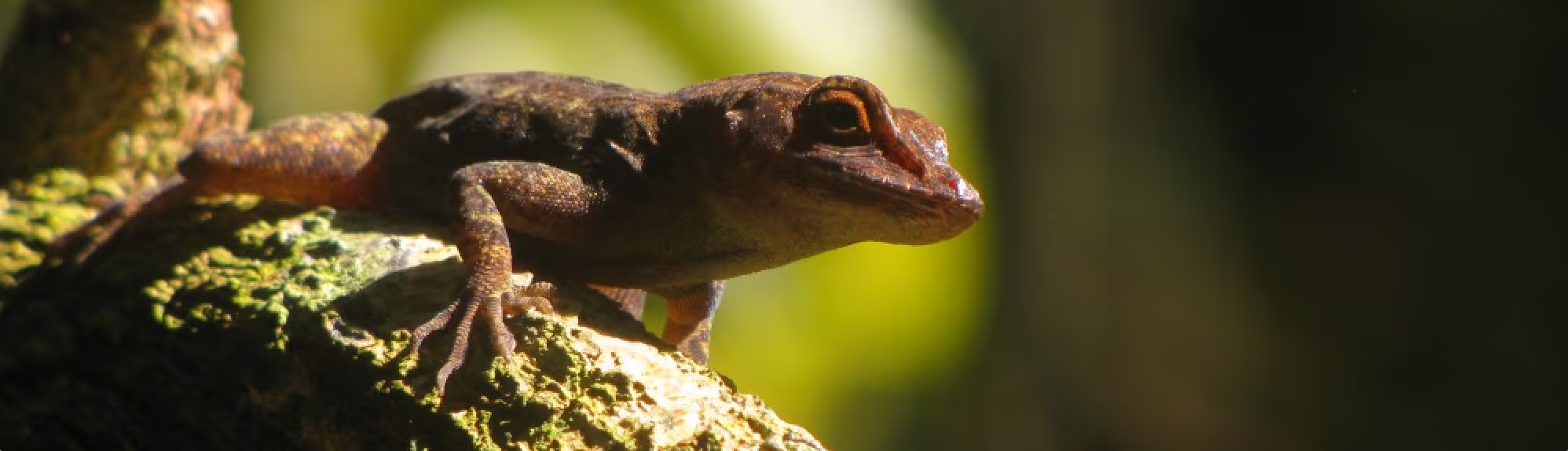
Recent scientific research has demonstrated that we don’t necessarily know why females choose to mate with the males that they do, nor should we be assuming that it is females doing all the choosing.29 For example, Emily DuVal’s decades-long studies of lance-tailed manakins have led her and colleagues to hypothesize that female manakins learn to choose mates by imperfectly copying other females’ mate choices, rather than consistently choosing any one male characteristic that somehow indicates the inherent “quality” or fitness of that male.30 Meanwhile, Jason Watters’s work on Coho salmon raises important questions about why biologists continue to expect, and hence perceive, females as always playing the “chooser” role in any given mating dynamic.31 His close observations of Coho salmon mating behaviors, coupled with an openness to considering new frameworks, provide evidence for multiple interpretations of who is choosing whom, and why. In sum, more recent scholarship is revealing that one does not have to be the “best” male, nor the “choosiest” female to survive and thrive, offering ways out of the racist and heterosexist logic that has long underlain sexual selection.
On perhaps an even more fundamental level, we argue that biologists must question their enduring assumption that an animal’s life is focused solely on reproduction, or that species survival revolves exclusively around procreative sex. Animals, including humans, need much more than sex to survive (and can certainly just have sex for fun), and so do not focus all of their energies on seeking sexual partners. Animals also need food, shelter, habitat, play, and nonsexual social interactions to produce the next generation successfully. Evolutionary biology’s near-obsessive focus on female mate choice or male fitness (and hence implicit investment in the sex binary, racial science, and eugenics) has long obstructed a much more capacious understanding of animal behavior, and effectively devalued and understudied all the life-saving and life-furthering contributions from both kin and non-kin.32 We advocate instead for an explicitly queer feminist, antiracist, and antiableist approach to biology: clearly it takes more than procreation, more than “fitness,” and more than two sexes, to support species surviving—and thriving!—across our social and natural worlds.
References:
1. Montañez, A. Beyond XX and XY: The Extraordinary Complexity of Sex Determination. Scientific American (2017) doi:10.1038/scientificamerican0917-50.
2. Velocci, B. The history of sex research: Is “sex” a useful category? Cell 187, 1343–1346 (2024).
3. Maung, H. H. Classifying Sexes. DiGeSt - Journal of Diversity and Gender Studies 10, (2023).
4. Richardson, S. S. Sex Contextualism. Philosophy, Theory, and Practice in Biology 14, (2022).
5. Fausto-Sterling, A. Rethinking Gender/Sex Identity. American Journal of Human Biology 37, e70044 (2025).
6. Roughgarden, J. Evolution’s Rainbow: Diversity, Gender, and Sexuality in Nature and People. (University of California Press, Berkeley, 2013).
7. Kamath, A. & Packer, M. Feminism in the Wild: How Human Biases Shape Our Understanding of Animal Behavior. (MIT Press, Cambridge, MA, 2025).
8. Roberts, D. E. Separating Racial Science from Racism. in Fatal invention: how science, politics, and big business re-create race in the twenty-first century 26–54 (New Press, New York, 2011).
9. Mukhopadhyay, C. C. Getting Rid of the Word ‘Caucasian’. in Everyday antiracism: getting real about race in school (ed. Pollock, M.) 12–16 (New Press, New York, 2008).
10. Nott, J. C., Gliddon, G. R. (George R. & Morton, S. G. Types of Mankind: Or, Ethnological Researches, Based upon the Ancient Monuments, Paintings, Sculptures, and Crania of Races, and upon Their Natural, Geographical, Philological and Biblical History. (Lippincott, Grambo, Philadelphia, PA, 1854).
11. Anderson, K. Race and the Crisis of Humanism. (Routledge, London, 2006).
12. Markowitz, S. Pelvic Politics: Sexual Dimorphism and Racial Difference. Signs 26, 389–414 (2001).
13. Miller, L. Why Fish Don’t Exist: A Story of Loss, Love, and the Hidden Order of Life. (Simon & Schuster, Incorporated, 2021).
14. Keel, T. Divine Variations: How Christian Thought Became Racial Science. (Stanford University Press, Stanford, California, 2018).
15. Reardon, J. & TallBear, K. “Your DNA is Our History”: Genomics, Anthropology, and the Construction of Whiteness as Property. Current Anthropology 53, S233–S245 (2012).
16. Kim, C. J. Dangerous Crossings: Race, Species, and Nature in a Multicultural Age. (Cambridge University Press, Cambridge, 2015). doi:10.1017/CBO9781107045392.
17. Collins, P. H. Black Sexual Politics: African Americans, Gender, and the New Racism. (Routledge, New York, 2004).
18. Parreñas, J. S. Arrested: Orangutan sexuality and the rehabilitation of wildness through captivity in Malaysia. History and Anthropology 30, 527–532 (2019).
19. Tang-Martínez, Z. Rethinking Bateman’s Principles: Challenging Persistent Myths of Sexually Reluctant Females and Promiscuous Males. J Sex Res 53, 532–559 (2016).
20. Monk, J. D., Giglio, E., Kamath, A., Lambert, M. R. & McDonough, C. E. An alternative hypothesis for the evolution of same-sex sexual behaviour in animals. Nat Ecol Evol 1–10 (2019) doi:10.1038/s41559-019-1019-7.
21. Bagemihl, B. Biological Exuberance: Animal Homosexuality and Natural Diversity. (St. Martin’s Press, New York, NY, 2000).
22. Panofsky, A. Misbehaving Science: Controversy and the Development of Behavior Genetics. (University of Chicago Press, Chicago, IL, 2014).
23. Schuller, K. The Biopolitics of Feeling: Race, Sex, and Science in the Nineteenth Century. (Duke University Press, Durham, 2017).
24. Stern, A. M. Eugenic Nation: Faults and Frontiers of Better Breeding in Modern America. (University of California Press, Berkeley, CA, 2015).
25. Sheldon, M. P. Breeding Mixed-Race Women for Profit and Pleasure. American Quarterly 71, 741–765 (2019).
26. Darwin, C. The Descent of Man, and Selection in Relation to Sex. vol. 1 (Murray, London, 1871).
27. Desmond, A. & Moore, J. Darwin’s Sacred Cause: Race, Slavery and the Quest for Human Origins. (University of Chicago Press, Chicago, IL, 2011).
28. Seth, S. Darwin and the Ethnologists: Liberal Racialism and the Geological Analogy. Historical Studies in the Natural Sciences 46, 490–527 (2016).
29. Kokko, H. & Mappes, J. Multiple mating by females is a natural outcome of a null model of mate encounters. Entomologia Experimentalis et Applicata 146, 26–37 (2013).
30. DuVal, E. H., Fitzpatrick, C. L., Hobson, E. A. & Servedio, M. R. Inferred Attractiveness: A generalized mechanism for sexual selection that can maintain variation in traits and preferences over time. PLOS Biology 21, e3002269 (2023).
31. Watters, J. V. Can the alternative male tactics ‘fighter’ and ‘sneaker’ be considered ‘coercer’ and ‘cooperator’ in coho salmon? Animal Behaviour 70, 1055–1062 (2005).
32. Gumbs, A. P. Undrowned: Black Feminist Lessons From Marine Mammals. (AK Press, Chico, 2020).