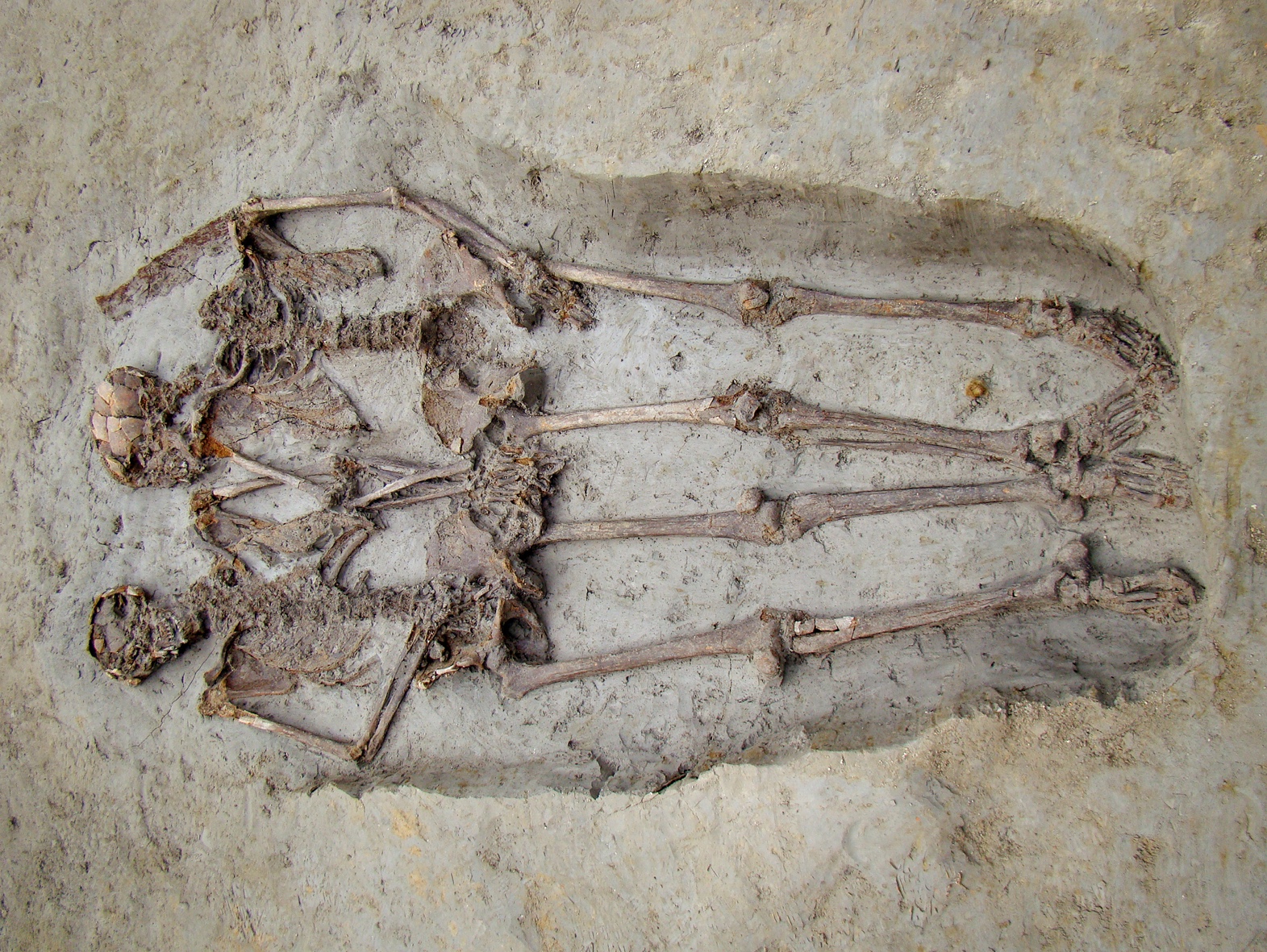
No matter where you are on this planet, human males are, on average, taller than human females. Sex-patterned differences in long bone length—specifically the tibia and femur (a.k.a. the shinbone and thighbone)—explain those height differences. Slight differences in skull size, vertebral thickness, and heel height add to height differences, as well. Our great ape relatives share our pattern. Chimpanzee, bonobo, gorilla, and orangutan males are bigger boned than females, though the degree of the sex difference varies by species. So, men’s greater average height is best understood through an evolutionary perspective. But how we might reasonably apply an evolutionary perspective to this phenomenon may come as a surprise to most readers. Not to be annoyingly coy, but let’s just say that the answer to the question about sex differences in height that you’re probably thinking of might not be up to 2025 snuff.
Back in 1871, Darwin fleshed out his idea of “sexual selection” with “the strongest and boldest men… in contests for wives”.1 Since then, competitive, dominant males winning the most mating bouts with choosy females, and creating more competitive dominant males in the process, has become the prevailing answer to the question of sex differences in size, including height. And it seems to be the preferred explanation for all sex differences. Evolutionary psychology being the popular, mainstream perspective on human evolution has certainly helped with that.
According to leading evolutionary psychologist David Buss, “sex differences in reproductive biology have created selection pressures for sex differences in sexual psychology that are often comparable in degree to sex differences in height, weight, upper-body muscle mass, body-fat distribution, testosterone levels, and estrogen production.”2 It seems the only way to apply sexual selection to human evolution is to assume distinct, evolved male and female psyches. In this popular paradigm,3 masculinity and femininity seem to be as inherited as curly hair. And so, it’s those essences, roles, or personas, if you will, of Man and Wife, that caused human height differences and whose very existence is evidenced by the fact that men are, on average, taller than women.
But Darwin’s Descent of Man came before much was known about bone growth biology, and even predated the word “hormone”.4 So what is the current understanding of bone growth and its sex-patterned variation?
Because height is an important part of what makes a man a man in American culture (and countless others around the world), and because testosterone is too, it’s taken for granted that men’s height is caused by testosterone. The most recent high-profile example I’ve seen is Scott Galloway’s book Notes on Being a Man.5 I have only listened to the audio version, so I do not know if he provided references. Though I doubt he included any for testosterone and male height. Why should he? He’s just talking common sense, even among many scientists.6 But is common sense correct? Is testosterone the reason that men are taller than women?
No. For all we know—which isn’t everything, but isn’t nothing, either—testosterone is not part of the reason that men are, on average, taller than women. And that causes problems for the sexual selection explanation and, by extension, some basic assumptions in evolutionary psychology. Before we reckon with that, let’s look at the actual facts of long bone growth.
Kids grow their bones like kids until puberty, at which point sex differences set in, and females stop growing sooner than males do. In the U.S., after nearly the same growth trajectory from two years of age, both males and females at 13 years are roughly 5’2” (or 157 cm) tall. After that, the female growth curve flattens out to reach the average final height of about 5’4” (163 cm). In males, the growth curve continues on roughly the same trajectory as childhood, for at least 1.5 more years, until it eventually flattens out to reach the average final height of about 5’10” (178 cm). This is an additional 9% of growth in males compared to females.7 What causes it?
Continued male growth at puberty, past the point when females stop, is due to estrogen’s effects on all human long bone growth and growth plate fusion. Estrogen is biphasic, causing long bones to lengthen (phase 1) until its levels increase enough to cause long bone fusion (phase 2), which is the end of growth. Because of their greater estrogen at puberty, females stop growing in height not long after the onset of menstruation. Without that surge of estrogen, males’ long bones stay in the growth phase for longer, before eventually experiencing growth plate fusion.8 Of course, many more factors than estrogen are involved in long bone growth and its cessation, but testosterone is not one of them. Without males’ greater levels of testosterone being the cause, sexual selection is harder to square as an explanation for their greater height.
Ever since Darwin, it’s been believed that men are, on average, taller than women because of ancestral, combative males attracting more females, winning more opportunities to reproduce, and, therefore, pushing their tall genes into the future more than the smaller losers did. Just another episode of “survival of the fittest” starring our ancestors’ evolved male and female psyches. But our mainstream Darwin-inspired story has got its work cut out for it if it’s to remain viable.
Different levels of estrogen in typical male and female bodies are due, in significant part, to sex differences in evolved reproductive physiologies involving differently functioning gonads and genitals. In all human bodies, fertility depends on a delicate balance of estrogen, not too much, not too little. Estrogen is as involved in males’ business as it is in females’ (not to mention all the non-reproductive business estrogen is always up to in everyone, as well). Sex-patterned estrogen levels in our sexually reproducing species are working well for existence (as opposed to extinction). But would they still work if selection for tall males—ratcheting up their height compared to females—were happening? To go the estrogen route would mean reducing it so long bone growth could occur for longer, but lower estrogen could diminish or eliminate fertility (by, for example, impacting sperm production and erectile function). And such an evolutionary route to taller males could also affect female estrogen and, hence, fertility as well. It’s worth noting that underneath all the factors that explain human height variation, there are millions of ways genetics can impact it.9 And, as of yet, there are no identified female- or male-specific genes for female- or male-specific biology of height.10
So, how are we supposed to jibe long bone biology with sexual selection? Maybe the more important question is, do we have to? Male-male competition causing male height is a story that we learned from Darwin and have recounted for over 150 years, but that’s not reason enough to keep telling it. What if we face the facts? For now, given all we know and don’t know about how bones grow, sex differences in height are reasonably explained as an accident or a by-product of estrogen’s role in our evolved reproductive system. This amount of human variation in height certainly works fine for human existence. And there’s no need to rely on theorized evolved psyches to make sense of it.
Of course, even if sex differences in long bones are only an accident, they can still have profound consequences. In mammals where males are larger than females, male harassment can inspire females to aggregate in response, as a way to counteract male behavior. And that female behavior, in turn, allows for single, or a few, males to monopolize a group of females and defend them (or at least appear to, as this could be about how males feel about males).11
The behavior we see in male gorillas and in other male mammals need not be theorized to be entirely inborn. Rather, one can remain an evolutionary thinker and appreciate the power of development in context. What if “male” behaviors can develop in species where males grow to be larger than females and, thus, where physical power is imbalanced between the sexes? Context like that, alone, can create some sticky social situations. So, do we really need to include theorized, evolved sexual psyches in the mix? Instead, maybe we should consider the possibility that males and females develop their minds and behaviors according to how their bodies develop in relation to one another and the rest of their world.12
How can we know whether sexual selection or the by-product story is the truth about men’s height? We cannot. Evolution is true, but we don’t have any way of verifying the sexual selection perspective on long bone growth differences in male and female humans or apes. We cannot whittle a man’s evolutionary “fitness” down to his height. Even in a world that swipes for height, there is no way to control for height, let alone to parse its true role among all the factors that contribute to a person’s survival and reproduction. To that, add the impossibility of knowing sexual selection for male height over deep time in our hominin ancestors. We cannot demonstrate that competitive males caused the evolution of male height, nor can we falsify it. That is, we also don’t have any evidence that sexual selection is not the truth. And, what’s more, we don’t have any evidence that sex differences in long bones are merely a by-product of reproductive physiology, as the estrogen biology seems to be demonstrating.
For the evolution of seemingly everything under the sun—from bipedalism, to big brains, to sex differences in height—debating the plausibility of evolutionary scenarios and choosing the winner has been, and continues to be, the only road to the truth. But is the most plausible truth the truth? If Darwin were not so fanatically revered, if scientists and the science-minded were not stuck in defense-attack mode against creationists, and if beliefs about evolved masculinity were not on the line, then it would simply be good science to ask whether an old idea about men’s height is still relevant to human evolutionary biology.
Moving forward, what are we to make of the belief that the evolved, competitive, dominant, aggressive, combative male psyche, and the evolved female psyche’s preference for it, exist, period, let alone that they caused the evolution of height differences or anything else about us? This seems like a good place to note that in 2019, philosopher Subrena E. Smith published a paper in Biological Theory titled “Is Evolutionary Psychology Possible?”13 Her answer is no.
References:
[1] Darwin, C. (1871). The descent of man, and Selection in relation to sex. John Murray. https://darwin-online.org.uk/EditorialIntroductions/Freeman_TheDescentofMan.html
[2] Buss, David. 2021. When Men Behave Badly. Little Brown Spark.
[3] A paradigm is a philosophical or theoretical framework for understanding or explaining things. Often, when something is referred to as a paradigm, it is the prevailing lens for making sense of something at that time in history. Roughgarden (2007) calls sexual selection a tautological system that morphs but never dies in the face of new evidence or thinking. (Challenging Darwin's theory of sexual selection. Daedalus 136 (2): 23–36. https://doi.org/10.1162/daed.2007.136.2.23) This is the danger of scientific paradigms, like sexual selection. They can become immune to scientific progress. That’s because paradigms aren’t always overthrown with new evidence. It often takes a new perspective on, or attitude about, the evidence to overthrow a paradigm. For a pathway into this discussion, see Feminism in the Wild by Ambika Kamath and Melina Packer (2025; MIT Press).
[4] Testosterone and estrogen continue to be called “male” and “female” hormones and also “sex hormones,” even by scientists. But all human bodies require sufficient levels of estrogen and testosterone for a multitude of functions, including those beyond sexual behavior and reproduction, many of which run all human bodies, not merely half of them. For a terrific review of these issues and more, see Williams et al., 2023, “Considering hormones as sex- and gender-related factors in biomedical research: Challenging false dichotomies and embracing complexity. Hormones and Behavior 156: 105442. https://doi.org/10.1016/j.yhbeh.2023.105442.
[5] Galloway, Scott. Notes on Being a Man. 2025. Simon and Schuster Audio.
[6] Here is a letter in Journal of Human Genetics (https://pmc.ncbi.nlm.nih.gov/articles/PMC12552116/) which assumes an androgen (including testosterone) explanation for men’s greater average height.
[7] Bogin B, Varea C, Hermanussen M, Scheffler C. Human life course biology: A centennial perspective of scholarship on the human pattern of physical growth and its place in human biocultural evolution. Am J Phys Anthropol. 2018; 165: 834–854. https://doi.org/10.1002/ajpa.23357
[8] For a lengthier treatment, see Dunsworth, H.M. 2020, Expanding the evolutionary explanations for sex differences in the human skeleton. Evolutionary Anthropology 29: 108–116. https://doi.org/10.1002/evan.21834
(To read it for free, without subscription: https://digitalcommons.uri.edu/cgi/viewcontent.cgi?article=1036&context=soc_facpubs)
[9] See Chapter 9 in She Has Her Mother’s Laugh by Carl Zimmer (2018; Dutton), especially his discussion of Pritchard’s 2017 work (An Expanded View of Complex Traits: From Polygenic to Omnigenic. Cell 169 (7): 1177-1186. https://doi.org/10.1016/j.cell.2017.05.038).
[10] But there is some recent literature about the investigation of the genetics underneath sex differences in height. Again, here is that letter in Journal of Human Genetics (https://pmc.ncbi.nlm.nih.gov/articles/PMC12552116/) which assumes an androgen (including testosterone) explanation for men’s greater height and which discusses a 2025 paper in PNAS that digs into height among people with sex chromosome aneuploidies (https://www.pnas.org/doi/pdf/10.1073/pnas.2503039122). The latter reports that average height increases across these genotypes in this order: X, XX, XXX, XY, XXY, XYY. Oddly, any effects on estrogen’s role in long bone growth and growth plate fusion are not considered in the authors’ interpretations of and speculations about these phenomena.
[11] Cassini, M. 2020. A Mixed Model of the Evolution of Polygyny and Sexual Size Dimorphism in Mammals. Mamm Rev 50 (1):112–120. https://doi.org/10.1111/mam.12171
[12] Dunsworth, H. & L. Ware. 2025. How can gender/sex entanglement inform our understanding of human evolutionary biology? In: Sex and Gender: Transforming Scientific Practice, edited by L. Z. DuBois, A. K. Trujillo, and M. M. McCarthy. Strüngmann Forum Reports, vol. 36, J. R. Lupp, series editor. Springer-Nature. https://link.springer.com/book/10.1007/978-3-031-91371-6
[13] Smith, S.E. 2019. Is Evolutionary Psychology Possible? Biological Theory 15 (1):39-49.